

askUnion
Designing and shipping an AI-supported enterprise knowledge assistant for onboarding and
internal knowledge sharing.
A practical GenAI knowledge assistant concept
and MVP created in the TU Darmstadt x Union
Investment collaboration, bridging user
research, product direction and real
implementation constraints.
Role
Product Owner &
Full-Stack Developer
Timeline
Nov 2025
- Feb 2026
Stack
React, TypeScript, Python, FastAPI, Azure OpenAI, Azure AI Search
SNAPSHOT
Context
A university-industry collaboration exploring how GenAI can improve internal knowledge transfer and onboarding in an enterprise environment.
SNAPSHOT
My Role
Product Owner responsibilities + UX research lead + cross-functional delivery (concept → prototype → frontend/ architecture contributions → reliability/security decisions).
SNAPSHOT
Problem
Internal knowledge was fragmented across people and tools, hard to access quickly and often dependent on who you knew and whether you felt comfortable interrupting them.
SNAPSHOT
Core Contribution
I turned qualitative research into a concrete product direction (journey mapping → “how might we” → flows/features) and then helped deliver an MVP-quality web app under enterprise constraints (identity, access control, deployment, reliability fixes).
SNAPSHOT
Outcome
A working internal knowledge assistant MVP with: chat + session history, “share knowledge” ingestion flow (documents + text), expert escalation loop, early feedback mechanics and an Azure-based RAG architecture.
Before and After narrative
BEFORE
Current-state experience
New employees and knowledge seekers lost time finding answers because information was distributed, inconsistently structured and sometimes outdated. When documentation failed, the most reliable path was asking colleagues, but that created social friction (“I don’t want to bother them”), increased dependency on individual experts and made onboarding efficiency highly variable.


*these 4 diagrams here are in heavily reduced form for presentation purpose and not showing our original research diagrams fully*
AFTER
Intended future state with askUnion
A guided system where employees can: ask questions in a chat interface grounded in internal sources, receive answers with clear confidence boundaries and when the system cannot answer, be routed to an appropriate expert so that the answer can be captured and reused, gradually reducing repeated interruptions and knowledge loss.
What I owned vs
what we did as a team
MY ROLE
In this project I personally owned:
-
PO responsibilities, backlog structure
-
UX research execution & synthesis (qualitative interviews → key needs/pain points, Personas)
-
User Journey Maps as a decision tool (turning research into opportunity areas), Empathy Maps
-
Product direction inputs (feature direction, functional and non-functional requirements, prioritisation of User Stories)
-
Figma Prototyping & flow design
-
React/TypeScript Frontend implementation
-
Backend/API integration (session behaviour, security/authorisation decisions, reliability fixes, documentation)
-
Deployment & CI/CD
-
Architecture / Documentation
-
I hold the final presentation in front of over 200 people with our Scrum Master together, where I was explaining Before and After narrative with the User Journey Map, Tech Stack Decision, Architecture, Expert Loop, Reflexion and more


MY ROLE
Team activities:
-
Parallel user research work
-
Parallel architecture work
-
Engineering implementation across frontend/backend
-
Stakeholder alignment
Research and insights
that drove
product decisions
RESEARCH
The System must reduce social friction:
People hesitate to ask colleagues because it feels interruptive and because they cannot easily judge who is the right person.
This insight justifies both:
(a) “ask the system first” and
(b) an expert escalation feature.
RESEARCH
The System must make scattered knowledge usable
Because information lives across multiple sources with inconsistent structure, the system must provide centrally accessible answers that respect confidentiality, context and relevance.
RESEARCH
The system must be honest about uncertainty
Because incorrect answers in an enterprise context can create real risk, the system must clearly communicate when it cannot answer based on internal sources. This insight directly justifies the expert loop and the need for human verification pathways.
Product Concept
as a System
This loop design is consistent with well-established “RAG + enterprise retrieval” patterns: Azure AI Search is explicitly positioned as a vector store/grounding layer for retrieval-augmented generation applications and enterprise knowledge bases. [SOURCE]
PRODUCT CONCEPT
The Ask Flow
Employees ask questions in a chat interface. The system retrieves relevant internal content and generates a grounded answer.
PRODUCT CONCEPT
The Share Flow
Employees can share new knowledge (documents or text) with metadata (e.g. visibility level, department), so that it becomes reusable instead of being trapped in private chats or individual memory.
PRODUCT CONCEPT
The Expert Loop
When askUnion cannot answer reliably from existing internal sources, it routes the user to a relevant expert. The answer can then be added back into the system, building long-term organisational memory and reducing repeat interruptions.
Implementation
& Engineering
Ownership
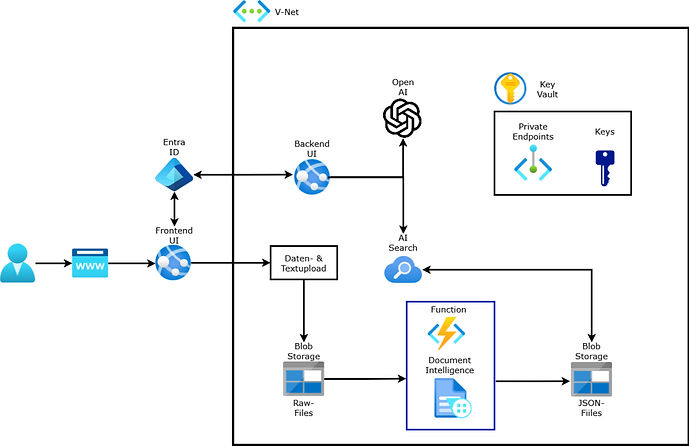
askUnion was not only a prototype. I worked across product and engineering to help ship a functional MVP in a real enterprise-like setup. My implementation contributions included frontend implementation in React/TypeScript, backend architecture of routes and integration with FastAPI, REST based communication for chat, uploads and session handling, protected routing with Entra ID SSO and delivery work such as deployment, CI/CD, delivery decisions, reliability and developer-facing documentation. The project also required working within enterprise constraints such as permissions, network hardening and deployment safety.
IMPLEMENTATION
Frontend for Full-Stack Application Architecture
-
React + TypeScript (Vite) frontend
-
FastAPI backend
-
Using Union Investment design system for enterprise-consistent UI
-
Chat flow, share flow, session handling, responsive UI
-
Structured split between UI, backend services, retrieval logic and storage
IMPLEMENTATION
REST APIs, routing and integration
-
REST flows for chat, upload, session management
-
API coordination between frontend and backend,
-
Route structure and documented API via Swagger UI for dev and testing
IMPLEMENTATION
Auth & Security
-
Microsoft Entra-ID Single sign-on (SSO) with OAuth2 Access Token (Bearer Token) and platform-level protection
-
Protected routes on frontend
-
Application-level JWT Validation & Scope enforcement with correct 401 and 403 behavior
-
Enterprise level authentification and authorization
IMPLEMENTATION
DevOps, Deployment, Delivery
-
CI/CD setup
-
Azure App Service Deployment
-
Branching strategy, troubleshooting, improvements that supported reliable delivery, documentation that made the system easier to maintain and easier for other developers to understand
Retrieval & Data Handling
RETRIEVAL & DATA HANDLING
Retrieval & Data Handling
The retrieval layer was designed to make internal knowledge more usable, not just more searchable. askUnion combined indexed document retrieval, session persistence and LLM-based response generation into a workflow that could support grounded answers and future knowledge reuse.
RETRIEVAL & DATA HANDLING
RAG-based response generation
Employees ask questions in a chat interface, the system retrieves relevant internal content and an LLM generates a grounded response from that retrieved context. This made the assistant more useful than a static search tool while keeping the answer generation tied to internal sources.
RETRIEVAL & DATA HANDLING
Document-structure
aware chunking
Retrieval quality depends heavily on how documents are chunked. A structure-aware approach improves the chance that meaning, context and proximity are preserved, which is important when answers are generated from enterprise documents rather than short standalone texts.
RETRIEVAL & DATA HANDLING
Data handling and session persistence
Knowledge uploads and chat sessions were persisted so that the system could support both knowledge sharing and conversation continuity. The ingestion pipeline transformed documents into chunks and embeddings, while the chat layer preserved usable session history as a core product capability.
RETRIEVAL & DATA HANDLING
Hybrid retrieval strategy
The retrieval approach combined semantic and keyword-based matching over an indexed knowledge base. This “best of both worlds” strategy is especially relevant in enterprise contexts, where exact wording and latent semantic similarity both matter.
Screens


My Key Decisions
This project became stronger when key product and engineering trade-offs were made explicit. The decision logs helped capture not just what changed, but why the change mattered for trust, reliability and delivery under enterprise constraints.
MY KEY DECISIONS
Defence-in-depth authorisation
Instead of relying only on platform authentication, I combined App Service protection with JWT validation and delegated scope enforcement inside FastAPI.
Why it matters: enterprise trust depends on access control being both real and explainable, including protected routes and clear 401 and 403 behavior.

MY KEY DECISIONS
Production outage and dependency drift
A production incident showed that the backend could fail before any network request because of dependency conflicts and SDK drift. I addressed the root cause by separating dev-only tooling, pinning the Blob SDK version and revalidating the deployment.
Why it matters: operational credibility depends on being able to diagnose, stabilize and redeploy under pressure.
MY KEY DECISIONS
Session integrity over
“click freedom”
When users switched sessions during an in-flight request, answers could end up in the wrong conversation. I prioritized predictable session behavior and made the session container the single source of truth, with switching blocked while a request was still sending.
Why it matters: reliability, continuity and user trust in chat history and session UX behavior.

*this image is a concept and just a prototype in figma to demonstrate the expert loop dashboard for seeing questions that could not be answered*
MY KEY DECISIONS
Expert loop to prevent confident wrong answers
The product was intentionally designed so that uncertainty could lead to human escalation instead of false confidence. When askUnion could not answer reliably from internal sources, the system concept routed users toward a relevant expert and created a path for knowledge to be captured back into the system.
Why it matters: risk reduction, gain of trust, still personal contact and better long-term knowledge capture with context to answer on questions and without the risk of losing knowledge
Outcomes
askUnion resulted in a working MVP delivered in an Azure test environment, not just a concept.
The implemented product included chat, session history and a structured knowledge-sharing flow as real core capabilities.
The project also showed that security, access control and enterprise trust had to be treated as product constraints from the beginning. That became visible not only in the architecture, but also in decisions around protected routes, authorization behavior and reliability fixes.
For me personally, the project became a strong proof point of how I work: research first, product direction through concrete decisions and implementation that stays grounded in real operational constraints. It connected UX research, product thinking, frontend implementation, backend integration and delivery discipline in one project.
With more time, I would extend the system in the areas that mattered most according to our User Research, especially according to the User Journey Map, to relieve the last pain points:
a richer feedback loop, expert-guided knowledge capture, dashboards for admins, stronger retrieval-quality controls and more explicit visibility and trust mechanisms for enterprise knowledge workflows.
I spent over 300 hours of work time in
this project.
Reflection
WHAT I WOULD DO NEXT
Feedback Loop
Ship a real feedback loop for helping developers prioritize decisions with structured labels (“incorrect”, “missing context”, “outdated policy”) extracted from saved comments besides thumbs


WHAT I WOULD DO NEXT
Expert Loop
Integrate the current email-based Expert Loop into askUnion, so that experts getting an email and getting redirected to askUnion to insert there knowledge there. With this we guarantee that minimum amount of knowledge is getting lost, no knowledge silos anymore, that the expert can see the exact context through messages and bringing some motivation through gamification inside askUnion App
WHAT I WOULD DO NEXT
Source Transparency
Knowledge uploads and chat sessions were persisted so that the system could support both knowledge sharing and conversation continuity. The ingestion pipeline transformed documents into chunks and embeddings, while the chat layer preserved usable session history as a core product capability.
WHAT I WOULD DO NEXT
Retrieval Quality & Security Roles
Add explicit retrieval security trimming and strict token budgeting, for example with role-based retrieval and classification.
WHAT I WOULD DO NEXT
Admin Dashboard
We need a administration and analytics layer for removing, adding knowledge and to see feedback for improvement, manage roles and so on
